A deck is the part of your house you actually live on. It takes the weather, the foot traffic, the grill, the furniture, and the weight of everyone you invite over, and it does that outdoors, year after year, in Middle Tennessee humidity. Built right, you stop thinking about it. Built cheap, you think about it every spring.
We build decks the first way.
What we build
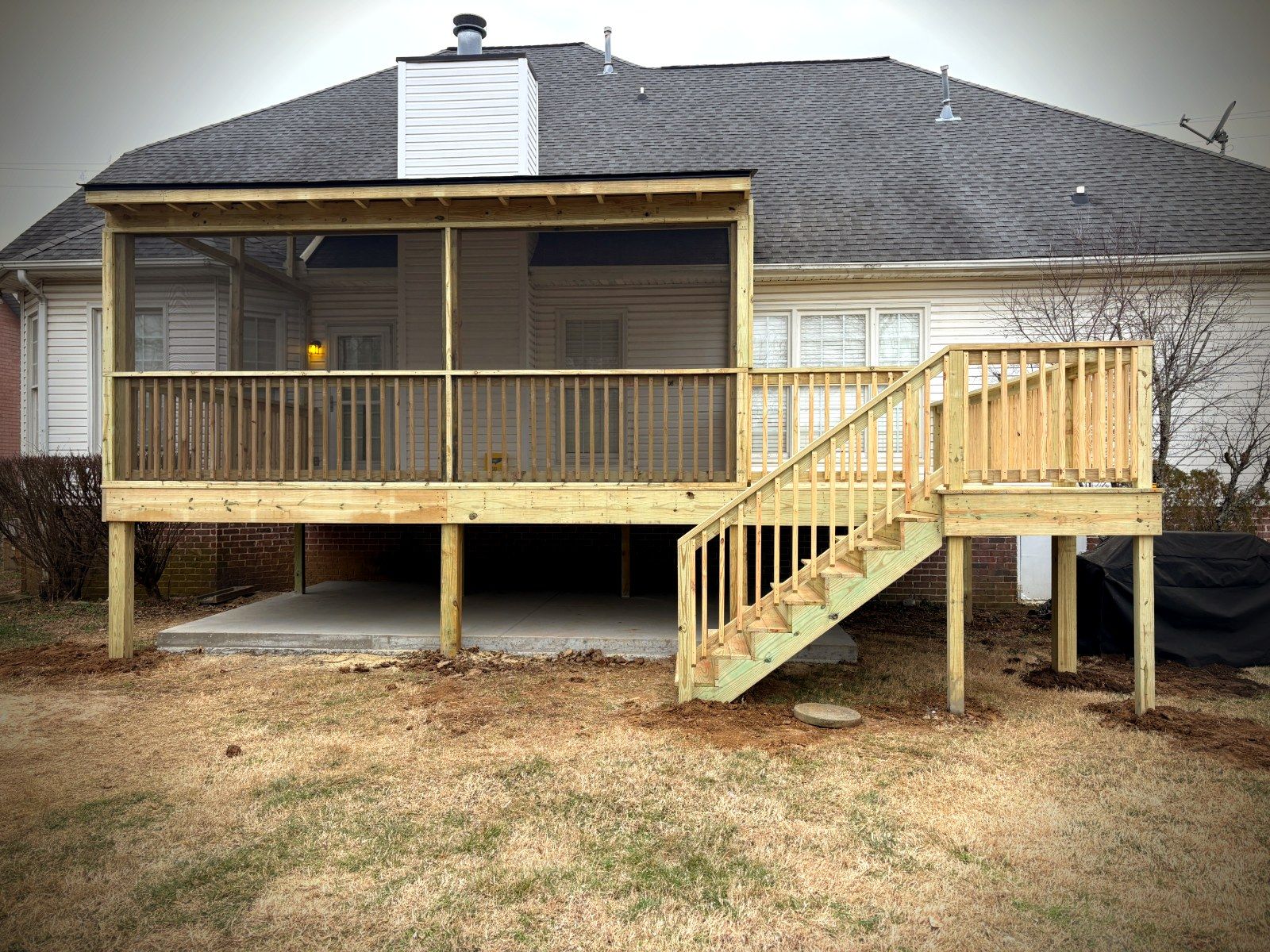
Ground-level and elevated decks. A ground-level deck is simpler and cheaper per square foot, but the drainage and ventilation underneath still have to be right or the framing pays for it. Elevated decks need proper footings, correctly sized beams, and stair geometry that meets code. The taller the deck, the less room there is for guesswork.
Multi-level decks. Where the yard slopes, stepping the deck down usually beats one tall platform with a long run of stairs. You get defined zones (dining up top, seating below) without a railing cutting the space in half.
Screened porches. Everything a deck is, plus a roof, screen framing, and a finished ceiling. Middle Tennessee summers make these the single most-used outdoor space on a lot of the properties we build for.
Box steps and stair systems. Wide box steps spanning the full face of a deck read better than a narrow staircase bolted to one corner, and they double as casual seating.
Railings. Wood, composite, cable, and black aluminum balusters. Height and baluster spacing are code items, not preferences. We set them right and the inspector never has a note.
Deck repair and restoration. Not every deck needs replacing. Often the framing is sound and the surface is finished, and we’ll tell you honestly which one you’re looking at, because there is no version of this where we make money selling you a rebuild you didn’t need.
Materials, and what actually holds up here
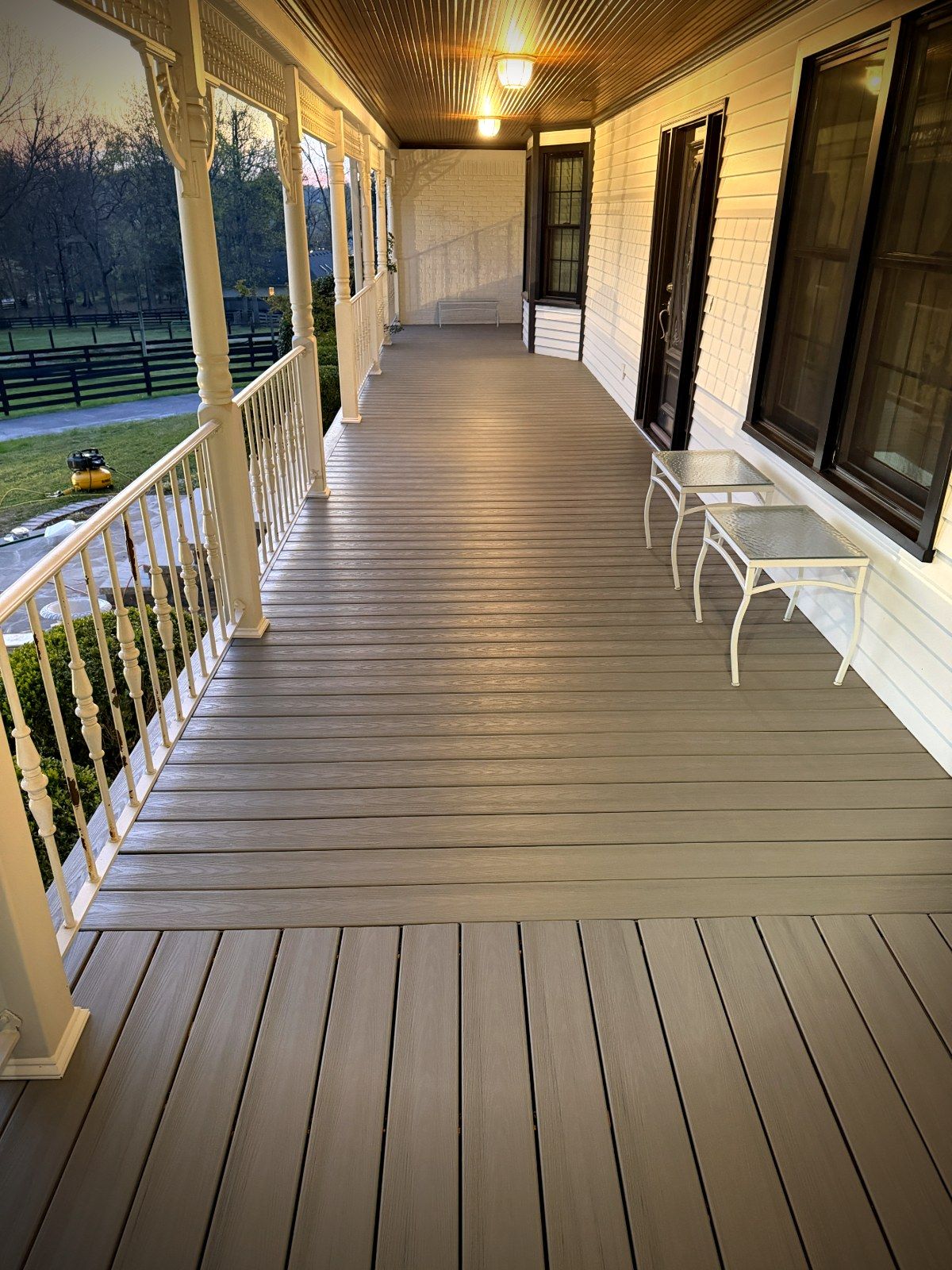
Composite: Trex and TimberTech. The strongest performer in this climate. It resists moisture, fading, and warping, and it doesn’t need sanding or resealing. Higher up front, lower over ten years, and no lost weekends. If you want a deck you never maintain, this is the answer.
Pressure-treated pine. The value option, and still the most common deck in Tennessee. It performs well if it’s detailed correctly and resealed every two to three years. Skip the resealing and it greys, checks, and splits. That’s not a material failure, it’s a maintenance one.
Cedar and hardwoods. Naturally rot-resistant, beautiful grain, warmer underfoot than composite in full sun. Costs more than pressure-treated and still wants periodic attention.
Fasteners. We use stainless steel screws, not nails. Nails back out as lumber moves through wet and dry cycles; screws don’t, and stainless doesn’t bleed rust stains down your boards. It costs more per box and it’s the reason there’s a screw in our logo.
Drainage and ventilation. Board spacing has to allow for expansion and contraction, and water has to have somewhere to go. Most deck failures we’re called out to repair are water problems that started as detailing shortcuts.
How a deck project runs
You call, we talk through what you’re picturing, and we come walk the site, no charge and no pressure. We look at grade, drainage, access, existing structure, and where the sun lands, because all four change what the right answer is.
You get a fixed-price quote that spells out materials, dimensions, and what’s included. Not an hourly estimate that drifts.
If your project needs a permit, we handle the application. If your neighborhood has an HOA, we prepare the drawings and documentation the board asks for so your submission is complete the first time. Permit requirements vary by county across our service area: Wilson, Davidson, Williamson, Rutherford, and Sumner all run their own process, and we deal with each of them regularly.
Once we agree on a plan, projects often start the same week.
Frequently asked
Do I need a permit for a deck?
Usually yes. Most Middle Tennessee jurisdictions require one for any deck attached to the house or over a certain size, and the threshold varies by county. We handle the application either way.
How long does a deck take to build?
Most residential decks run a few days to about two weeks on site, depending on size, height, and whether there’s a roof involved. Weather and permit timelines are the usual variables, and we tell you about both up front.
Composite or pressure-treated?
If you plan to stay in the house a while and don’t want to maintain it, composite wins on ten-year cost and on weekends recovered. If budget is the constraint, pressure-treated is genuinely fine, as long as you commit to resealing it every two to three years.
Can you build on a steep or sloped lot?
Yes, and it’s common here. Slope usually means deeper footings and often a multi-level design. We’ll tell you at the walkthrough what the grade means for the build.
Do you repair decks you didn’t build?
Regularly. We’ll assess the framing and give you a straight answer about whether it’s a repair, a resurface, or a rebuild.