A fence has one job description and about six jobs: privacy from the neighbors, containment for the dog, safety around the pool, a boundary that matches the survey, and a line that looks intentional from the street. Getting all of that at once comes down to material choice, post setting, and whether whoever built it paid attention to your terrain.
Middle Tennessee terrain is not flat, and it is not forgiving. Rock is shallow in a lot of Wilson and Williamson County, clay holds water in others, and a fence line that ignores either one leans within a couple of seasons.
What we install
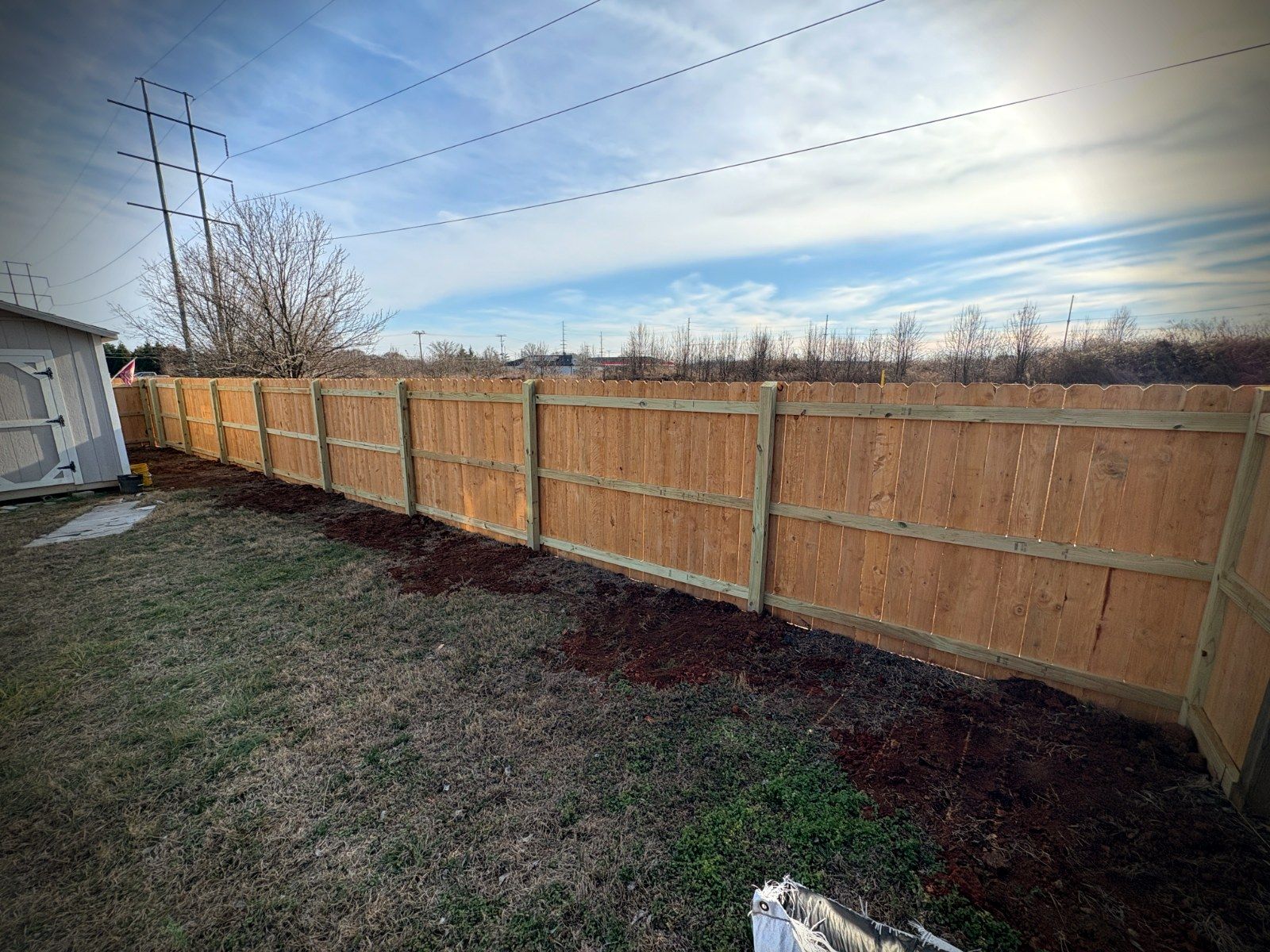
Wood privacy fence. The most common request we get. Six-foot is standard, eight where codes allow and you want real separation. Board-on-board and shadowbox give you privacy from both sides without the flat, one-sided look of a basic stockade run.
Stockade and dog-ear. Straightforward, economical, and quick to install over long runs. A good answer when you’re fencing acreage rather than a small yard.
Aluminum. Powder-coated black aluminum is what most HOA neighborhoods around here specify. It won’t rust like wrought iron, it keeps sightlines open, and it handles grade changes cleanly because the panels can rack to follow slope. Common around pools, where code has specific height and spacing requirements we build to.
Vinyl. Low-maintenance and consistent in appearance, with no staining, no resealing, no greying. Higher up front than wood and it stays looking new far longer.
Chain link. Commercial and residential. Not glamorous, and unbeatable when containment and cost are the whole brief.
Farm and split-rail. For acreage, pasture, and the properties out toward College Grove and the county lines where the fence is defining land, not a yard.
Custom gates. Single, double, and drive gates, built to match the fence rather than ordered from a catalogue and made to fit. Gates are the part of a fence that moves, so they’re the part that fails. Proper posts, proper hardware, and proper bracing are the whole game.
Repairs
Storms take out sections. Posts rot at grade. Gates sag until they drag. Ground shifts and a run goes out of plumb.
We repair fences we didn’t build, and we’ll tell you when a repair is genuinely the right call versus when you’re better off replacing a run. A leaning section with sound posts is a repair. Rotted posts across a whole line is not. Patching that is money spent twice.
Post setting, which is the entire job
Everything above ground is determined by what happens below it. Posts get set below the frost line, in concrete, plumb, and at spacing appropriate to the material and the wind exposure. On rocky ground that means drilling rather than augering. On clay that means paying attention to drainage so the post isn’t sitting in a bathtub.
Skip any of that and the fence tells on you within two seasons. This is the single most common reason we get called to fix somebody else’s work.
Permits, HOAs, and property lines
Most Middle Tennessee municipalities require a permit for a new fence, and height limits differ between front, side, and rear setbacks. Pool fencing has its own code requirements. We handle the permit application.
If your neighborhood has an HOA, we prepare the drawings and material specifications the board needs. We’ve submitted to boards across Franklin, Brentwood, Spring Hill, and Mount Juliet neighborhoods, and we know what a complete application looks like.
One thing we won’t guess at: your property line. If there’s any ambiguity about where the boundary sits, we’d rather you have a survey than have us set posts in the wrong place. Moving a fence because it landed on a neighbor’s ground is the most expensive mistake in this trade, and it’s entirely avoidable.
Frequently asked
How much does fence installation cost?
Typically $30–$65 per linear foot installed across our service area, depending on material, height, and terrain. Rock, slope, and demolition of an existing fence all move the number. We quote fixed prices, not hourly.
How long does it take?
Most residential fences go up in one to three days once materials are on site. Permit and HOA approval timelines are usually the longer part of the calendar.
Which material lasts longest?
Aluminum and vinyl, comfortably. Neither rots and neither needs refinishing. Among woods, cedar outlasts pressure-treated pine. All of them outlast a bad post installation, which is the actual variable.
Do you remove the old fence?
Yes, including haul-away. It’s a line item in the quote so you can see it.
Can you fence a sloped yard?
Yes. Aluminum panels rack to follow grade. Wood is either stepped or racked depending on the look you want, and we’ll show you the difference at the walkthrough, because they read very differently from the street.